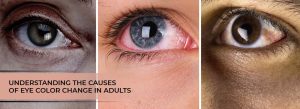

[vc_row][vc_column width=”1/1″][vc_column_text]This is an intriguing query! A mystical feature of the body is the eye. While the idea of how the body bends its fingers or digests food is pretty simple to comprehend, it is incredible that these small wet spheres can see. The ability to distinguish between things in even the smallest quantity of light requires more than just being able to see. And if that weren’t enough, the iris has fascinating and lovely color dynamics. But why do people have different colored eyes?
Here are the reasons:[/vc_column_text][us_image image=”7858″ size=”full” align=”center”][vc_custom_heading text=”What Exactly Determines Your Eye Color?” use_theme_fonts=”yes”][vc_column_text]Melanin, a protective protein in your hair, skin, and eyes, gives your iris its distinct color.
Your iris has a bluish hue when no melanin is present, which is why most newborns are born with blue eyes. Melanin begins to build in the eye for up to six months following birth as you grow.
The quantity of pigment found on your iris’s two surfaces determines your eyes’ precise hue. In contrast, eyes with dark brown eyes have more melanin on their backs than those with little (or no) melanin on their fronts.
- Genes:
DNA carries instructions
Your DNA contains the instructions needed to create and maintain you. DNA makes up each gene, which contains the instructions for a little portion of you.
So a gene controls whether you have red hair or not. And one that determines whether you can taste PTC, a bitter molecule. So on.
Some characteristics are too complex to originate from a single gene. Instead, numerous genes join together to produce these features. For instance, a collection of genes is required to educate a cell to become a nerve cell. A group of genes is also necessary to instruct a cell in the iris of the eye to create a specific amount of melanin.
- Chromosome:
A crucial region of 15 is used to determine eye color.
Two genes in this region that are close to one another are OCA2 and HERC2. Melanosome formation involves the P protein, which is an OCA2 gene product and a cellular structure that makes and stores melanin. Therefore, the P protein is essential for the quantity and quality of melanin in the iris.
Frequent variations (polymorphisms) in the OCA2 gene result in a reduction in the amount of functional P protein produced. People with this gene’s polymorphism have blue eyes instead of brown because there is less P protein, resulting in less melanin in the iris.[/vc_column_text][us_separator][us_image image=”7835″ size=”full”][vc_custom_heading text=”Different colored eyes: identify which eye color is the cause of what” font_container=”tag:h3|text_align:left” use_theme_fonts=”yes”][vc_column_text]
- Melanin, which acts as an insulator for the connections between brain cells, is more prevalent in the iris of those with brown eyes. They may shoot more quickly than their light-eyed colleagues as a result. According to research, macular degeneration may be less likely to strike someone with brown eyes.
- Compared to blue eyes, grey eyes are darker and contain fewer melanin pigments. The number of melanin pigments and protein density in the iris determines whether someone has grey eyes.
- The color of hazel eyes is between the lightest blue and the deepest brown. This is because the anterior margin of the iris has a significant quantity of melanin. Some experts claim that eye color can vary significantly in the first several years of life.
[/vc_column_text][vc_column_text]Therefore, nothing alarming about having different-colored eyes if you were born with them. However, if you start to detect a change in the color of your eyes, this might be a sign of a more serious medical condition. You ought to visit your eye doctor as soon as you can.[/vc_column_text][/vc_column][/vc_row]