
Healthy Habits to Prevent your Eye Problems

healthy eye habits to prevent eye problemsHealthy Eye habits

10 Healthy Habits to Prevent Your Eye Problems for a Long Time

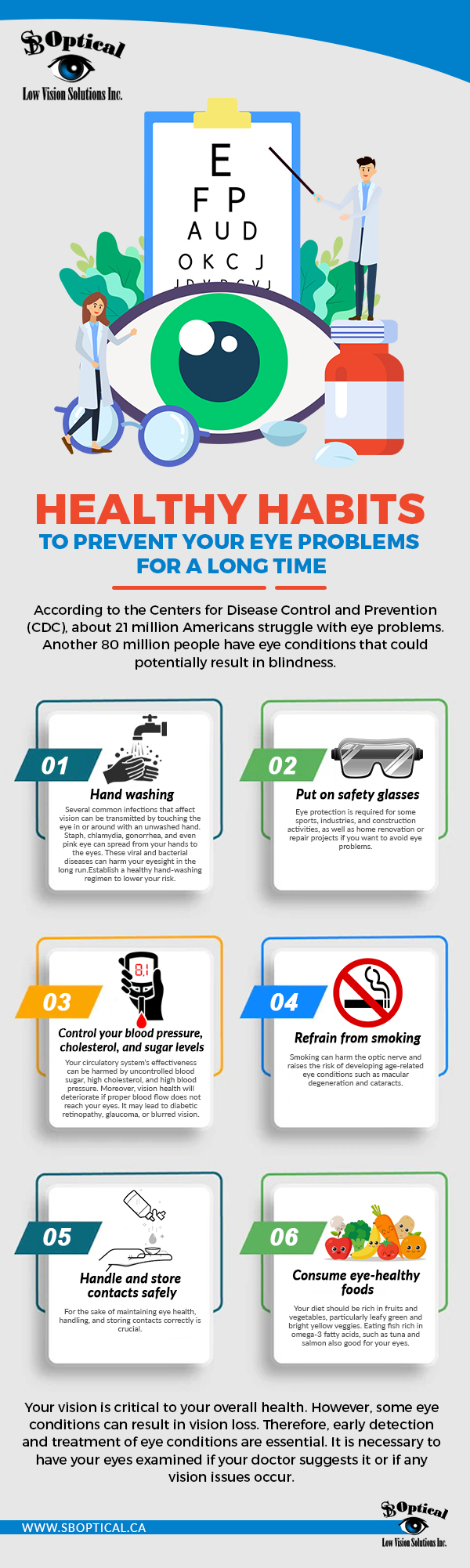
According to the Centers for Disease Control and Prevention (CDC), about 21 million Americans struggle with eye problems. Another 80 million people have eye conditions that could potentially result in blindness.
Your quality of life would drastically change without vision. Fortunately, science has a wealth of knowledge regarding the root causes of visual issues. You can safeguard the health of your eyes by adopting these ten easy habits.

healthy eye habits to prevent eye problemsHealthy Eye habits

Also read: Common Eye Problems Symptoms to be Looked for in Children
Healthy Habits to Prevent your Eye Problems

10 Healthy Habits for Prolonged Vision

1. Hand washing
Several common infections that affect vision can be transmitted by touching the eye in or around with an unwashed hand. Staph, chlamydia, gonorrhea, and even pink eye can spread from your hands to the eyes. These viral and bacterial diseases can harm your eyesight in the long run.
If you haven’t just cleansed your hands, avoid touching anything near your eyes for petty reasons.

2. Handle and store contacts safely
For the sake of maintaining eye health, handling, and storing contacts correctly is crucial. Some tips to prevent eye problems:

Avert prolonged wear.
Do not reuse a solution.
When the solution expires, discard it. A small amount of waste is preferable to an eye infection.
Without cleaning your hands, never touch your contacts.

3. Steer clear of harmful cosmetic procedures
One of the most crucial organs you possess is your eyes. Avoid risky processes like iris tattooing and needless lid lifts at the expense of your eye health.
Even the use of cosmetic contacts without your optometrist’s approval can be dangerous and extremely harmful. In simple words, they are not worth the nuisance.

4. Put on safety glasses
Eye protection is required for some sports, industries, and construction activities, as well as home renovation or repair projects if you want to avoid eye problems.

5. Consume eye-healthy foods
Your diet should be rich in fruits and vegetables, particularly leafy green and bright yellow veggies. Eating fish rich in omega-3 fatty acids, such as tuna and salmon also good for your eyes.

6. Exercise
Exercise reduces stress, regulates blood sugar, and enhances blood flow. Get some workout every day and raise your heart rate to maintain healthy eyes.

7. Control your blood pressure, cholesterol, and sugar levels
Your circulatory system’s effectiveness can be harmed by uncontrolled blood sugar, high cholesterol, and high blood pressure. Moreover, vision health will deteriorate if proper blood flow does not reach your eyes. It may lead to diabetic retinopathy, glaucoma, or blurred vision.

8. Rest your eyes
Using a computer for extended periods can cause eye strain. The 20-20-20 rule can aid in lessening eye fatigue. The process involves looking away every 20 minutes for 20 seconds to approximately 20 feet from you.

9. Refrain from smoking
Smoking can harm the optic nerve and raises the risk of developing age-related eye conditions such as macular degeneration and cataracts.

10. Consult an eye care specialist
Visit your optometrist routinely. They will be able to detect problems early and advise you on lifestyle modifications that will help you preserve your eyesight longer.

Conclusion

Your vision is critical to your overall health. However, some eye conditions can result in vision loss. Therefore, early detection and treatment of eye conditions are essential. It is necessary to have your eyes examined if your doctor suggests it or if any vision issues occur.

Moreover, maintaining good eye health is vital as maintaining good physical health. One set of eyes is all you get.Use these healthy habits to maintain their well-being.
Five Common Eye Problems in Children & Their Remedies

common eye problems

[vc_row][vc_column width=”1/1″][vc_column_text]Do your children find it hard to read? Are your children rubbing their eyes a lot? Children are more likely to have eye problems. Children are increasingly exposed to mobile phones and laptops, which has led to an increase in common eye problems.

It is important to recognize the problem and take appropriate actions to ensure they can perform daily activities without any difficulty.

Let’s take a look at common eye problems that children may have and how we can treat them. It is important to recognize the symptoms that children with common eye problems have before we get into the details.[/vc_column_text][vc_custom_heading text=”Common Eye Problems Symptoms to be Looked for in Children” use_theme_fonts=”yes”][us_image image=”7513″ size=”full” align=”center”][ultimate_spacer height=”10″][vc_custom_heading text=”Common Eye Problems Symptoms to be Looked for in Children” use_theme_fonts=”yes”][vc_column_text]Children with common eye problems are most likely to experience the following symptoms:

  • Poor focus
  • Sensitivity to light
  • Reading difficult
  • Eye redness
  • Inability to see distant objects or the blackboard
  • Rub your eyes
  • Too close to the TV

[/vc_column_text][vc_custom_heading text=”Common Eye Problems for Children” use_theme_fonts=”yes”][vc_column_text]

Amblyopia (Lazy Eye):

Amblyopia is an eye condition that causes the brain not to process the inputs coming from one eye, and in time, begins to ignore the inputs. This blocks the development of vision in the weaker eye, resulting in long-term vision problems. Common signs of amblyopia are squinting and poor depth perception and eye wandering or head tilting, among others. It can be treated with glasses, eye patches, and drops for the eyes. A pediatric eye doctor may consider surgery in certain cases.

Chalazion:

It is a swelling of the upper or lower part of the eyelid that is caused by blockage or swelling of the oil gland. At first, it’s not painful but when it becomes infected, the swelling can spread to the entire eyelid and causes pain. It could even increase than normal and cause a cover to the pupil of the child and cause common eye problems. Small chalazion typically disappears at their own pace within a few months but larger and infected ones need to be treated with liquid drops for the eyes, a warm compress surgical drainage, or removal.

Astigmatism, Farsightedness, And Near-sightedness:

The three conditions, known as refractive errors are the most frequent eye issues in both adults and children. They usually result from defects on the cornea’s surface which prevent light from getting focused onto the retina. The condition can be treated through prompt diagnosis by wearing prescribed lenses or glasses by a doctor.

Strabismus:

It is a condition in which eyes move in a different direction and aren’t properly aligned when focusing on an object. Children may be born with strabismus or they get it as they grow older. However, if it lasts for a longer time and causes amblyopia, the condition can be aggravated. It can be treated as early as age 0 using eye patches and exercises, as well as glasses, etc.

Epiphora:

This is an affliction where children experience constant excessive tearing or watery eyes. It’s caused by an obstruction in the tear ducts inflammation, ocular surface disorders, or allergies. It usually improves over a while but should it continue to persist and is not resolved, it can be treated by using eye drops, massage, and minor surgeries.[/vc_column_text][vc_column_text]Prevention is better than treatment. Regular check-ups with an eye specialist are the best way to prevent children from developing common eye problems. These check-ups should be done at least once per year. By doing so, potential and common eye problems can be detected early so that treatment can begin before they become worse. 

It is possible for children to not be able to see when their vision is impaired so parents should be vigilant. Parents need to make sure their children don’t spend too much time on digital screens and encourage them to engage in other activities. They should also be alert for signs that a child may have an eye problem.[/vc_column_text][/vc_column][/vc_row]

Top Four Tips for Your Eye Care, Maintain Good Eye Health

eye care tips

Eye Care is Crucial at Every Stage of Life:

This is because it increases the quality of eye care in an individual’s life. Poor vision or blindness affects individuals and families in many ways. Good eye health or eye care is important to read, cook, watch drive and do many other tasks in our day to day life. Regular check-up of eyes is required as it helps in detecting vision problems or eye diseases if any. But taking eye care must be done right from a young age to maintain eye health. Some of the basic to advanced tips of eye care is given below:

Maintain Good Food for your Eye Health:

Food that we eat plays a vital role in providing nutrients to our body and thus helps in eye care. Omega 3 fatty acids, zinc, vitamin C and E beta carotene help regain vision problems. Cataract and macular degeneration are age-old eye problems that tend to happen at a later age. Green leafy vegetables are good for eyes. Having carrot and beetroot juice is another way for eye care. Eggs, nuts, protein derived from non-meat sources, citrus fruits such as oranges and lemons, oysters are some other foods that help in overcoming eye-related problems by providing necessary nutrition. Tuna, mackerel, herring, salmon, sardines contain the most important levels of omega 3s. Vitamin E is present in nuts such as peanuts, cashew nuts, lentils and also it contains omega 3 fatty acids. Flax seeds and chia seeds too are good for eye health.

Vitamin A is a component of rhodopsin that helps the retina to absorb light. Those who are non-vegetarians can relish on chicken breast, pork and beef for the necessary nutrients. Eggs are rich sources of vitamins C, e, zinc, lutein, Zeaxanthin, etc. that are highly beneficial for eyes especially age-related eye problems. Vitamin  D helps in reducing macular degeneration risk.

Be careful with Type 2 Diabetes:

It leads to vision problems in some cases that might even cause blindness. To avoid one from getting type 2 diabetes controlling weight by taking a balanced and healthy diet is needed.

Stop Bad Habits:

Smoking is bad and injurious to our health in various ways. It affects the optic nerve by damaging it. Cataracts and macular degeneration are some of the medical problems associated with it.

Water for Eye Care:

Last but not least water is essential for the smooth functioning of life and hence vital to eye health. A lot of water is required to help overcome dehydration. Hydration is helpful for dry eyes.